

contentVerticalPosition: , overrideVerticalAlignment: , contentHorizontalPosition: , overrideHorizontalAlignment:
contentVerticalPosition: , overrideVerticalAlignment: , contentHorizontalPosition: , overrideHorizontalAlignment:
Neuromechanics Research Group
We are a group of researchers from engineering and neuroscience dedicated to understanding:
1. How healthy humans control their upper limb movements.
2. What goes wrong in movement disorders.
3. How to use technology to evaluate, assist, and rehabilitate people with movement disorders.
1. How healthy humans control their upper limb movements.
2. What goes wrong in movement disorders.
3. How to use technology to evaluate, assist, and rehabilitate people with movement disorders.
News
Catch up on everything happening in our lab!
Lab receives NIH award to advance tremor decomposition method for personalized treatment of Essential Tremor

Tremor, the most common movement disorder (estimated to affect at least 6-9% of persons aged 60 or older in the US), can make activities of daily living (eating, clothing, grooming, etc.) difficult or impossible. Medication and surgical interventions are only partially effective, and only in a subset of patients, leaving many patients without effective treatment options. The goal of this work is to lay the groundwork for effective tremor suppressing strategies by refining and applying a method we recently developed to determine which muscles are most responsible for an individual’s tremor, providing insight into where to intervene to suppress tremor in an optimal manner.
Read Full Story
New Study Maps How Upper-Limb Biomechanics Shape Hand Tremor
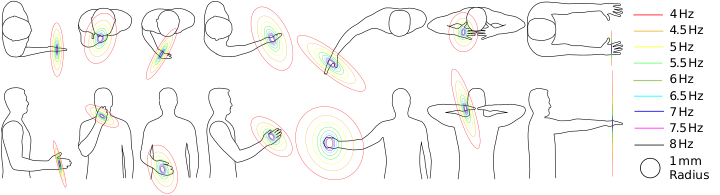
A new study by our lab published in Computers in Biology and Medicine presents the first model of tremor propagation from upper-limb muscles to the hand. Simulations across 50 muscles and seven postures show that tremor direction depends strongly on posture, wrist muscles have the greatest consistent influence, and single-frequency tremor produces characteristic elliptical hand paths. These findings may help guide tremor assessment and peripheral suppression strategies.
Read Full Story
New Method Identifies Which Wrist Muscles Contribute to Tremor

A new study by our lab published in Annals of Biomedical Engineering demonstrates a method for quantifying the contributions of individual muscles to hand tremor. In 14 people with Essential Tremor, the flexor carpi radialis contributed most to constrained wrist tremor on average, followed by the flexor carpi ulnaris and extensor carpi radialis. However, the dominant muscles varied between individuals, highlighting the potential value of personalized approaches to peripheral tremor suppression.
Read Full Story
Feel Free to reach out!