

Lab News
Berkeley Hamaker wins 2nd place for research presentation

At the recent BYU Life Sciences Research Conference, Berkeley Hamaker (third
Lab receives NIH award to advance tremor decomposition method for personalized treatment of Essential Tremor

Tremor, the most common movement disorder (estimated to affect at least 6-9% of persons aged 60 or older in the US), can make activities of daily living (eating, clothing, grooming, etc.) difficult or impossible. Medication and surgical interventions are only partially effective, and only in a subset of patients, leaving many patients without effective treatment options. The goal of this work is to lay the groundwork for effective tremor suppressing strategies by refining and applying a method we recently developed to determine which muscles are most responsible for an individual’s tremor, providing insight into where to intervene to suppress tremor in an optimal manner.
New Study Maps How Upper-Limb Biomechanics Shape Hand Tremor
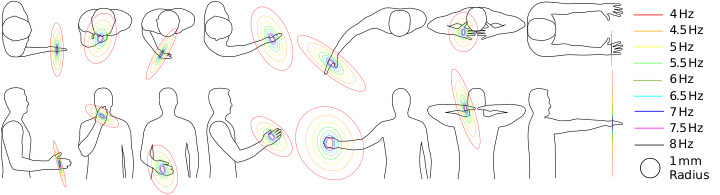
A new study by our lab published in Computers in Biology and Medicine presents the first model of tremor propagation from upper-limb muscles to the hand. Simulations across 50 muscles and seven postures show that tremor direction depends strongly on posture, wrist muscles have the greatest consistent influence, and single-frequency tremor produces characteristic elliptical hand paths. These findings may help guide tremor assessment and peripheral suppression strategies.
New Method Identifies Which Wrist Muscles Contribute to Tremor

A new study by our lab published in Annals of Biomedical Engineering demonstrates a method for quantifying the contributions of individual muscles to hand tremor. In 14 people with Essential Tremor, the flexor carpi radialis contributed most to constrained wrist tremor on average, followed by the flexor carpi ulnaris and extensor carpi radialis. However, the dominant muscles varied between individuals, highlighting the potential value of personalized approaches to peripheral tremor suppression.
Ten Students Attend the Rocky Mountain ASB Conference

This year 10 students from our lab attended the 2023 Rocky Mountain ASB(American Society of Biomechanics) Conference, an unprecedentedly high number for our lab. In total, our lab accounted for 6 of the podium presentations as well as 2 of the poster presentations. In the awards ceremony, we were well represented with 3 of our students earning special recognition. Nolan Howes was recognized as the Student-Choice Podium Presentation, Samantha Nelson was recognized as the Student-Choice Poster Presentation, and Jacob Cox was awarded the Best Undergraduate Poster Presentation. To learn more about the Rocky Mountain ASB conference or read abstracts for each presentation, visit https://sites.google.com/site/asbrockymountain/home.
PhD Student Daniel Free goes far in 3MT competition

3MT is a popular graduate student competition in which students have 3 minutes to present their thesis using only one slide. Recently, a Phd student from our lab, Daniel Free, participated in such a competition sponsored by BYU. Daniel successfully proceeded through several levels of the competition, winning first at the department level, next at the college level, and then moving on to be 1 of only 11 students chosen to compete in the university-wide competition. To see Daniel's presentation and learn more about 3MT at BYU visit https://gradstudies.byu.edu/gss/3mt
Lab Visit: Francisco Valero-Cuevas

On February 15th, Francisco Valero-Cuevas, an accomplished professor from USC's Department of Biomedical Engineering flew in to visit our lab. During his stay, he was able to spend a significant amount of time with our graduate students providing both insight and guidance for their current research. Professor Valero-Cuevas later presented his research and methodologies to a body of BYU students and professors alike. To learn more about Francisco Valero-Cuevas, check out his lab's website: https://valerolab.org/
Manuscript Accepted: Essential Tremor Accentuates Upper Limb Coherence Patterns

Essential Tremor accentuates the pattern of tremor-band coherence between upper-limb muscles
Accepted Manuscript: Feasibility of Leap Motion Controller Motor Tests

Feasibility of using the Leap Motion Controller to administer conventional motor tests: a proof-of-concept study
Accepted Manuscript: Wrist and Forearm Movement Preferences

Movement preferences of the wrist and forearm during activities of daily living
overrideBackgroundColorOrImage=
overrideTextColor=
promoTextAlignment=
overrideCardHideSection=
overrideCardHideByline=
overrideCardHideDescription=
overridebuttonBgColor=
overrideButtonText=